Teaching the Next Generation: Advances in Neurosurgical Education
DOI:
https://doi.org/10.46900/apn.v8i2.374Keywords:
Neurosurgery/education, Simulation Training, Education, Medical, GraduateAbstract
Neurosurgery is a highly complex surgical specialty with one of the longest and most demanding learning curves in all of medicine — one in which patient safety is not merely an ethical imperative but the organizing principle of the entire educational process. Since the first formal residency programs were established by William Osler and William Stewart Halsted at Johns Hopkins Hospital in Baltimore, this structured training model has expanded worldwide and become the gold standard for surgery education. Harvey Cushing, widely regarded as the father of modern neurosurgery, built upon this foundation to establish neurosurgery as a distinct discipline, training a generation of surgeons who carried his standards across the country and around the world. Arthur E. Walker later formalized this legacy by creating the world's first dedicated neurosurgery residency program at the same institution.
For much of the twentieth century, the philosophy underpinning surgical education was elegantly captured in the dictum attributed to Halsted: "See One, Do One, Teach One." In its time, this framework was transformative. Today, however, the conditions under which surgical competence can be developed through traditional methods have changed profoundly. Reduced surgical caseloads, evolving ethical standards governing patient care, and mandatory restrictions on residents' weekly working hours have created a structural tension at the heart of surgical training: the demand for technically excellent, clinically confident neurosurgeons has not diminished, but the traditional pathways for producing them have been significantly constrained. Modern residency programs have responded by placing increasing emphasis on simulation-based training before direct patient interaction — a shift that is reshaping the culture and infrastructure of neurosurgical education worldwide.
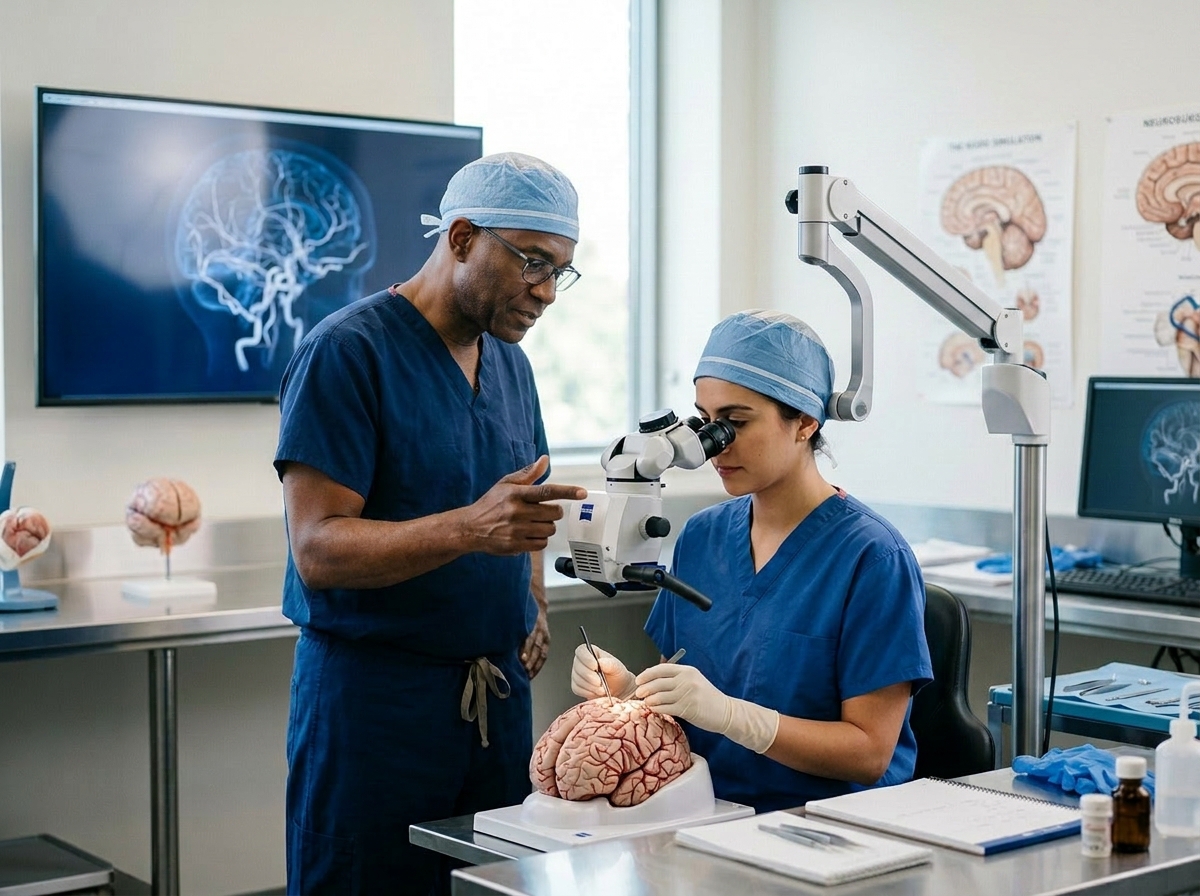
Simulation in neurosurgery serves two complementary and equally important functions. The first is clinical planning: technologies such as virtual reality, augmented reality, and three-dimensional printing allow surgical teams to reconstruct patient-specific anatomical models and rehearse complex or unusual procedures before entering the operating room. This application is particularly valuable in rare or anatomically challenging conditions, where prior exposure to similar cases may be limited and the consequences of intraoperative surprises can be severe. In many instances, a simulation is developed specifically for a single complex case, functioning simultaneously as a planning instrument and a rehearsal environment. The second function is educational, and it is here that the field has seen its most dynamic growth. Cadaveric dissection, purpose-built surgical simulators, scenario-based learning, and structured competency frameworks now form the backbone of progressive neurosurgical training programs, allowing the principles of deliberate practice to be applied with a frequency and intentionality that the traditional operating room rarely permits.
Within this landscape, pediatric neurosurgery has emerged as a particularly arena for innovation. The relative rarity of many pediatric neurosurgical conditions, their concentration in specialized centers, and the unique anatomical and physiological characteristics of the developing nervous system make supplementary simulation training not merely beneficial but essential. The development, implementation, and rigorous validation of multiple simulation platforms in this subspecialty have placed pediatric neurosurgery at the vanguard of technological innovation in neurosurgical surgical education. Most significantly, the integration of artificial intelligence into simulation environments is beginning to transform training from a passive rehearsal experience into an adaptive, personalized learning system — one capable of analyzing trainee performance with granular precision, identifying specific areas of weakness, and adjusting the focus and difficulty of training tasks in real time to optimize each individual's learning trajectory.
It is in direct response to these developments, and in the spirit of the educational tradition that stretches from Halsted and Cushing to the present day, that the book “Advanced Teaching Methods in Neurological Surgery” is currently in its final stages of preparation. The volume provides a comprehensive and practically oriented overview of innovative approaches to neurosurgical education, integrating foundational principles of medical and surgical pedagogy with the full spectrum of emerging technologies. It addresses curriculum design, competency-based assessment, cadaveric dissection, surgical simulation, scenario-based learning, and the growing role of artificial intelligence, augmented reality, and virtual reality in both teaching and evaluation. It is intended as a valuable resource for educators, program directors, residents, and medical students — offering practical strategies to enhance technical skills, clinical decision-making, and patient safety in the context of modern neurosurgical training.
The history of neurosurgery is, in a profound sense, a history of education. The challenge facing neurosurgical educators today remains fundamentally the same one Harvey Cushing faced more than a century ago: how to prepare the next generation of surgeons to deliver the highest standard of care to patients who trust them with the most complex organ in the human body. The tools available to meet that challenge now extend far beyond what Cushing or Walker could have imagined — yet the values they embodied, precision, dedication, and commitment to the patient, remain as relevant today as they were at the founding of our specialty.
The Editors Pediatric Neurosurgery
Downloads
Published
How to Cite
Issue
Section
License
Copyright (c) 2026 Matheus Ballestero, Ricardo Santos de Oliveira

This work is licensed under a Creative Commons Attribution 4.0 International License.

When publishing in Archives of Pediatric Neurosurgery journal, authors retain the copyright of their article and agree to license their work using a Creative Commons Attribution 4.0 International Public License (CC BY 4.0), thereby accepting the terms and conditions of this license (https://creativecommons.org/licenses/by/4.0/legalcode).
The CC BY 4.0 license terms applies to both readers and the publisher and allows them to: share (copy and redistribute in any medium or format) and adapt (remix, transform, and build upon) the article for any purpose, even commercially, provided that appropriate credit is given to the authors and the journal in which the article was published.
Authors grant Archives of Pediatric Neurosurgery the right to first publish the article and identify itself as the original publisher. Under the terms of the CC BY 4.0 license, authors allow the journal to distribute the article in third party databases, as long as its original authors and citation details are identified.