Surgical treatment of unilateral lambdoid craniosynostosis with revolution spiral osteotomy: a case report
DOI:
https://doi.org/10.46900/apn.v8i2.340Keywords:
lambdoid synostosis, craniosynostosis, osteotomyAbstract
Introduction/Background: Lambdoid craniosynostosis (LC) is the premature fusion of the unilateral or bilateral lambdoid suture. It is a rare condition associated with neurodevelopmental implications across different ages. Therefore, early diagnosis and treatment are crucial for a positive outcome.
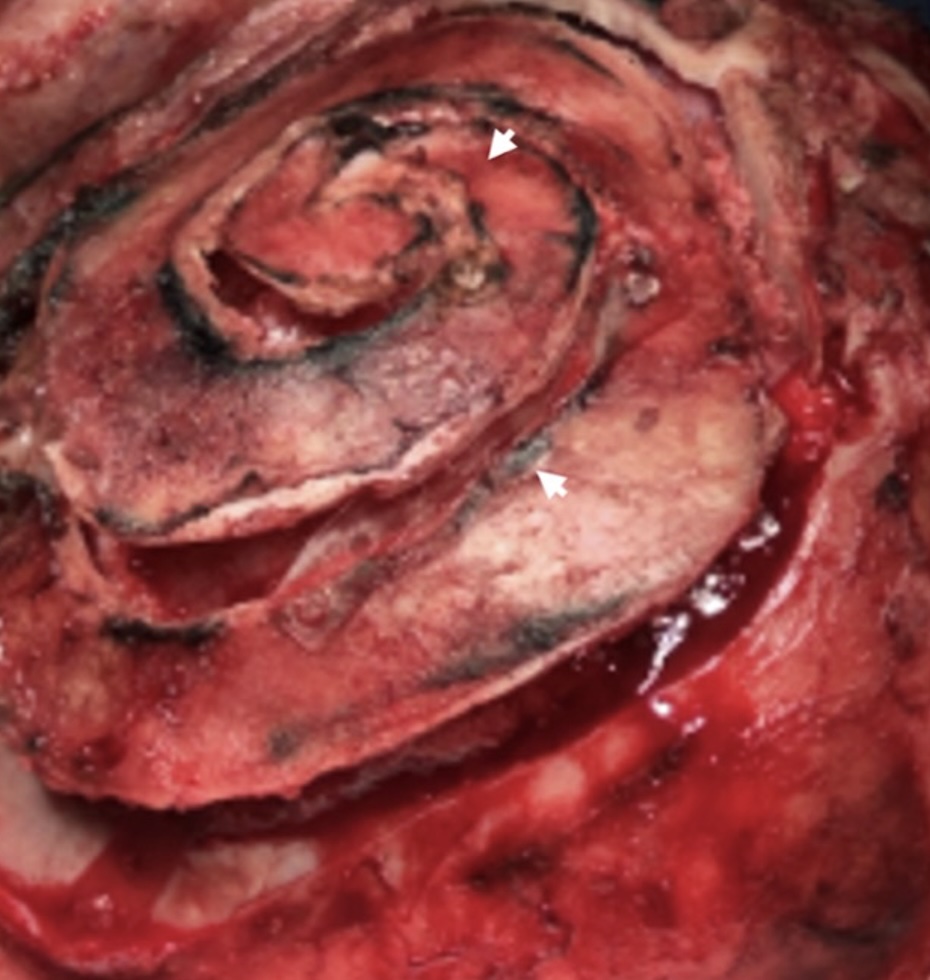
Case Presentation: Here, we report the case of an 11-month-old male patient diagnosed with LC, presenting facial shift and altered ear positioning consistent with the condition. For the case, we employed the revolution spiral technique, a less invasive corrective method that minimizes bone loss and reduces postoperative morbidity. The patient showed no complications during surgery and was then evaluated 3 months after surgery, showing correction of the cranial deformity and no procedure-related complications.
Conclusions : We propose the revolution spiral technique as an effective alternative for the surgical management of LC, with minimal associated risks.
Downloads
Published
How to Cite
Issue
Section
Categories
License
Copyright (c) 2026 Angelo Silva Neto, Rodolfo Diógenes Paixão, Derick Pedrosa Pachá, Lauren Beatriz Gomes Fortes, Guilherme Lucas de Oliveira Lima

This work is licensed under a Creative Commons Attribution 4.0 International License.

When publishing in Archives of Pediatric Neurosurgery journal, authors retain the copyright of their article and agree to license their work using a Creative Commons Attribution 4.0 International Public License (CC BY 4.0), thereby accepting the terms and conditions of this license (https://creativecommons.org/licenses/by/4.0/legalcode).
The CC BY 4.0 license terms applies to both readers and the publisher and allows them to: share (copy and redistribute in any medium or format) and adapt (remix, transform, and build upon) the article for any purpose, even commercially, provided that appropriate credit is given to the authors and the journal in which the article was published.
Authors grant Archives of Pediatric Neurosurgery the right to first publish the article and identify itself as the original publisher. Under the terms of the CC BY 4.0 license, authors allow the journal to distribute the article in third party databases, as long as its original authors and citation details are identified.